
“Successful IT companies rely on a scalable business model”
In an interview with Johannes Rasch, Managing Partner at SAR – Scaling Champions, Tobias Wielki, Managing Director of Vertec Germany, talks about scaling effects in IT companies, “hidden champions” and the digitization of business processes.
Tobias Wielki: Perhaps you could tell us very briefly what you do, how SAR was founded and what purpose the company serves.
Johannes Rasch: As Sar, we scale IT companies. Many IT system houses, digital agencies and IT service providers exchange time for money – precious time of scarce IT employees for a clear lot of money. With increasing comparability, many can only define themselves by price. This leads to margins falling further and further. Many companies also fail to reach and convince their desired customers.
But there are also IT companies that attract repeatable and predictable customers, have a scalable quote or product, and thus become market leaders in their segment, like a “hidden champion.” We call these companies “scaling champions” and believe that they own the future. They will become the decisive driver of digitization and thus the backbone of the new economy.
Our focus is clearly on scaling IT companies. Every year, we accompany around 70 customers on this path and work closely with them for at least six months. Workshop and coaching as well as mutual exchange within the “Scaling Champions Community” lead to tangible results and joint growth.

Tobias Wielki: Why should I not continue as an IT company? Why should I rethink my processes and myself, scale or aim for a larger margin?
Johannes Rasch: A company should have one goal: It should benefit its desired customer – today and in the future. To work on maximizing benefits for the customer in the long term, it takes expeditions, visions and strategic work. The basis for this is high margins. They create freedom and scope for manoeuvre for the further continuous improvement of solutions and quotes. Scaling and larger margins are therefore not an end in themselves, but serve to create ever-increasing benefits.
Successful IT companies are working to become number one in their market with a scalable business model that optimally generates above-average profits, margins and greater customer value.
This is exactly what our podcast episode number 19 is all about.
Tobias Wielki: If we imagine a company like Vertec, what would you do to achieve scale effects?
Johannes Rasch: As a company, Vertec is already well positioned in many ways. There is a fundamental misconception that often causes scaling initiatives to end in a dead end. Many companies start to develop the perfect quote or product, which often takes months or years and in the end the whole thing has to be “only sold”. But many never reach this point or realize much too late that the target group would have needed something completely different or the desired price does not fit. This is the main reason why scaling fails.
For us, the scaling of a customer is built up in four stages:
1. Clear target customers and positioning
Identification of the clear desired customer group through structured conversations with customers and leads. Unique selling points and positioning are tailored to this. We follow a clear principle: “It’s better to be first in the village than second in the city.” This means first becoming number one in a smaller target market and then expanding bit by bit.
2. Predictable customer acquisition
Building repeatable channels such as webinars, partner bring forwards and white papers to reach new customers at scale and attract new leads without cold acquisition or marketing agency. Many of our customers gain more than 30 leads per month from B2B decision makers.
3. Repeatable sales process
Clear (pre-) formats such as workshops, webinars or demo sessions and scripts for the acquisition and onboarding of new customers. This significantly reduces the time of the sales cycle.
4. Scalable Products and Solutions
Development of a repeatable customer journey with scalable solutions and services. A major lever here lies in the pricing of the solutions. Instead of being compensated for the time spent, we consistently develop a pricing strategy that is oriented towards customer benefit. On the one hand, this constantly increases the value for the customer, on the other hand, generates profits through the multiple use of solutions.
Tobias Wielki: As a reaction to the advancing digitalization, you will probably also experience that companies have a digital strategy in mind or want to implement it concretely. What are your experiences with this?
Johannes Rasch: In the IT industry, we are experiencing exactly what we believe will have to happen in other industries in the coming years. There is no such thing as thinking in terms of digital strategies in a tech company. At some point, digital solutions and systems will become DNA, a natural tool for making processes more efficient, thinking radically differently about interactions with customers, and developing new business models. “Digital” is a tool for implementing one’s own strategies – nothing more and nothing less. When exploring the subject, it certainly makes sense to start with a digital strategy. In the medium term, however, this should be incorporated into the overall corporate strategy.
Tobias Wielki: Is a scaling/strategy without the digitization of business processes conceivable or meaningful?
Johannes Rasch: No, definitely not. Real scaling effects only occur when you look at the processes end-to-end and set them up in a scalable manner. This applies to both customer acquisition and service provision. We often observe that many companies do not begin to standardize and digitize their processes. Their portfolio often resembles a tummy shop, new solutions are constantly being developed. The complexity continues to increase. The scaling effect is mainly about setting a clear focus, doing things multiple times and then automating.
Tobias Wielki: Be this standard for your customers or is it more of a marginal issue?
Johannes Rasch: Digital business processes are becoming increasingly important in IT companies. Our customers develop scalable products or services during the time they work with us, attract new customers in a repeatable manner and convince them with a clear process. This is the foundation of scaling.
The next step is to push things up even further. But not just with more HR. That would be the same pattern that we are using now. The right way is to make the processes more efficient and automate them. There are classics that have an immediate effect: modular offer templates, automated emails, automatic onboarding of customers, training via videos or online group calls. We look not only at the business process of our customers’ desired customers, but also at the internal processing process.
Tobias Wielki: What Role does the digitization of business processes play in this?
Johannes Rasch: Up to a certain size, it may all be possible with 100 different systems and Excel lists. But at the latest when scaling really starts, a solid infrastructure is needed. A good example of this is integrated CRM and ERP systems. They map the entire sales cycle without data redundancies and can automate recurring business processes such as invoicing.
Another example is one of our customers who used to write every quote in Word, sometimes for hours. Today, when the customer signs up for a free webinar, the customer data is centralized in the CRM. The information is enriched about the sales process, so that an individual quote of service packages can be compiled with just a few clicks. This saves everyone involved a lot of time and helps sales to focus on deepening customer relationships while at the same time attracting new customers. That’s real scaling.
Tobias Wielki: Thank you very much for the exciting exchange.



The review package for future-proof Vertec installations


How to Use AI Features in Vertec with Full Sovereignty


Give your Vertec the right flavor

Has structured data died with the AI revolution?
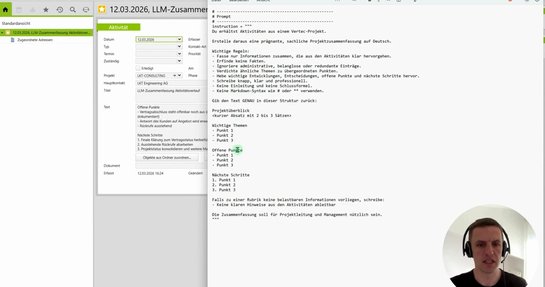
AI in Vertec: the new LLM Client in Python 3
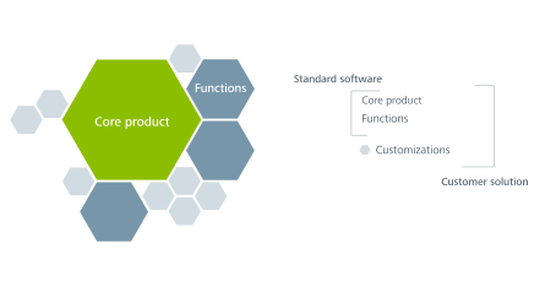
Update capability and adaptability in Vertec: a technical area of tension

30 years as a software entrepreneur