
GwG Revision 2026: What Law Firms and Fiduciaries Need to Know Now
New Compliance Obligations, New Processes – and Why Digital Solutions Are Crucial
On 1 October 2026, the revised anti-money laundering legislation (AML) will enter into force in Switzerland. The changes entail a significant enhancement of the scope of application: For the first time, significantly more consulting firms and fiduciaries will fall under the AML obligations.
For many law firms and ficuciary companies, this means a fundamental change. The due diligence obligations that were previously reserved for financial intermediaries will now also apply to selected advisory activities. This will increase not only the regulatory requirements, but also the requirements for internal processes, documentation and organisation.
The central question is therefore not only:
“Are we affected?” but also: “How can the new requirements be implemented efficiently and sustainably in day-to-day business?”
Who is affected by the GwG revision 2026?
The revision expands the scope of companies that may be subject to the Money Laundering Act (GwG).
In particular, consultancy services in connection with certain economic transactions may trigger a GwG subordination. This includes, among other things, service types relating to:
- Formation, structuring or sale of companies
- Purchase and sale of companies
- Certain real estate transactions
- Domiciliation services
- Management of non-operating companies
As a result, the audit also affects many law firms and fiduciaries that have not previously been faced with AML requirements. The previous assumption “We do not manage customer funds and are therefore not affected” will no longer apply in all cases in the future. The decisive factors are which services are provided and whether they fall within the scope of the new legal setting.
Consulting and participation can already become relevant
One of the most important changes concerns the scope of service type.
It is not only the execution of a transaction or the management of assets that can trigger an AMLobligation. Professional consulting or participation in certain transactions may already be relevant in the future.
This changes the perspective for law firms and fiduciaries:
The decisive question is no longer just:
”Do we manage our customers’ assets?”
Increasingly:
”Do we assist customers in service types that fall under the new GwG provisions?”
This new approach requires a detailed analysis of one’s own services and mandate processes.
The following test diagram illustrates the essential test steps at a glance.
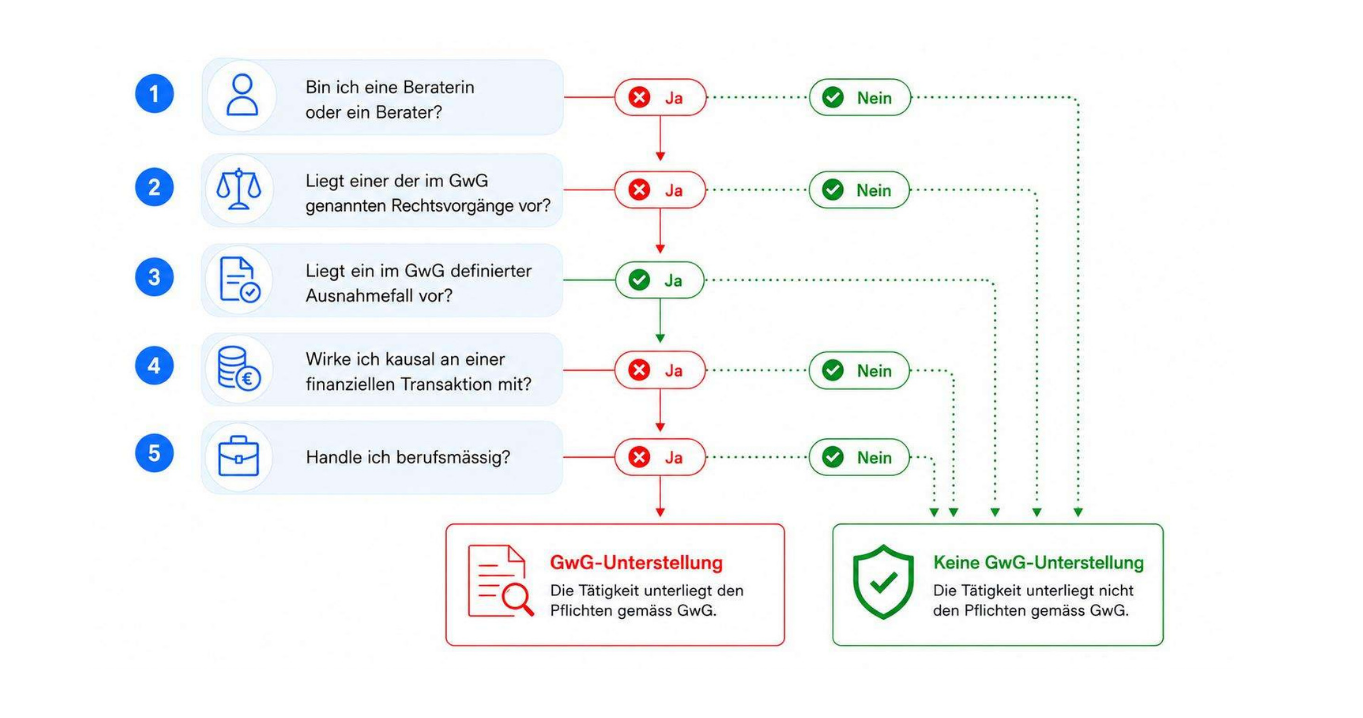
What does a GwG subordination mean in concrete terms?
Companies that will be subject to the GwG in the future will be subject to various new obligations.
These include in particular:
Identification of Contracting Parties
Customers and contracting parties must be clearly identified. This is not only about the entering of root data, but also about comprehensible documentation of identification.
Identification of beneficial owners
Companies need to clarify who is actually behind a business relationship and who benefits economically from it.
Particularly in the case of complex company structures, this can cause a significant audit effort.
Risk assessments
Business relationships must be assessed in terms of potential risks. This requires structured processes and clear criteria.
Documentation and proof requirements
The fulfilment of the duties of care must be traceable at all times.
In future, it will no longer be enough to know information. It is crucial that this information can be documented, kept up to current and proven during inspections.
New demands on organisation and internal processes
In addition to the direct duties of due diligence, auditing also entails organisational challenges.
Affected companies need, among other things:
- Internal settings and processes
- Clear responsibilities
- Training for employees
- Control mechanisms
- Traceable documentation of the measures taken;
Especially for law firms and trust companies, the biggest challenge is not the one-time entering of information.
The real challenge is to integrate these requirements permanently and consistently into everyday work – across different cases, employees and business processes.
Why manual processes reach their limits
Many companies today work with a combination of ERP systems, Excel lists, Word documents and individual filing systems.
This approach may work for simple requirements. However, with increasing regulatory requirements, challenges quickly arise:
- Information is distributed in different systems
- Updates are not centrally documented
- Audits are difficult to trace
- Employees work with different processes
- The effort required for reviews is increasing
The revision of the GwG therefore also shows an organisational opportunity: compliance processes can be rethought and integrated more digitally.
Mapping compliance where cases arise
The most efficient solution is not to think of compliance as an additional process to day-to-day business.
Rather, relevant information and audits should be entered where the mandate work takes place.
An integrated digital solution enables:
- Structured entering of compliance-relevant information
- Comprehensible documentation of tests
- Clear processes for employees
- Greater transparency about cases and risks
- Less manual steps
In this way, compliance does not become an additional burden, but an integral part of efficient work processes.
Vertec supports the integration of compliance processes
Vertec enables law firms and fiduciary companies to integrate compliance processes directly into existing case and workflows.
Checklists can be used to process and document tasks as early as the opening of a case. Relevant information can be entered in a structured manner, audits can be documented in a comprehensible manner and compliance requirements can be linked directly to existing processes.
Depending on the requirements, specialized solutions and service providers can also be integrated.
This does not create an additional isolated solution, but a central working environment in which mandate management and compliance processes interact efficiently.
Now is the right time to prepare
With the regulations coming into force as early as October 2026, companies should now consider:
- Which services will be affected in the future?
- Which processes need to be adapted?
- What information will have to be documented in the future?
- How can employees be supported efficiently?
Acting in time not only creates regulatory certainty, but can also modernize existing processes and make them more efficient.
The 2026 revision of the GwG is thus not only a new compliance requirement – it is also an opportunity to make mandate processes more digital, transparent and sustainable.
Practical insights from our event of July 8, 2026
Our event on 8 July 2026 showed just how pressing and relevant the GwG revision 2026 is. Together with Michèle Landtwing Leupi, Legal Partner at MME, and Maximilian Reinhard, CPO & Co-Founder of Legalian, we examined the impact of the revision on law firms and fiduciary companies.
The focus was on the questions of which services may be covered by the GwG provisions in the future, which organizational adjustments will be required and how the new due diligence and documentation obligations can be efficiently integrated into existing workflows.
The discussions and questions from the audience have made it clear that the uncertainty surrounding the new regulations is strong and the need for practical solutions is correspondingly high. Many companies are currently busy aligning their processes to the new requirements in good time while keeping the administrative hours within limits.
All content and further information can be found in the presentation slides:
If you have any questions, please do not hesitate to contact us.


The Vertec MCP server has outperformed the RAG system

The idea behind the Vertec MCP Server


The review package for future-proof Vertec installations


How to Use AI Features in Vertec with Full Sovereignty


Give your Vertec the right flavor
Has structured data died with the AI revolution?


Online event for fiduciaries: Trustee services as a subscription