Podcast: Urs Prantl and Claudio Pietra on Strategy
Urs Prantl invited me in his podcast “Prantls 5A | Strategy Spotlight on unique IT companies”. Learn exciting backgrounds on the history of Vertec, what the current challenges are and with which strategy Vertec wants to grow in the future.
Listen on Spotify or Prantls 5A Podcast.

If you want the essence, you will find it here in five Learnings.
1. Standard software and customization are not mutually exclusive
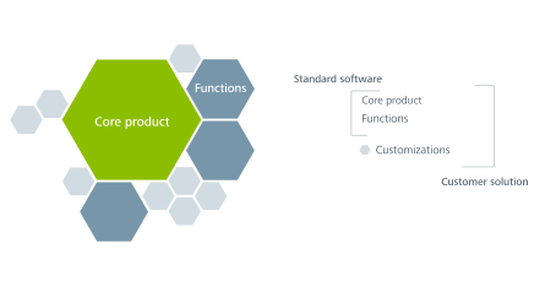
Vertec was created as standard software from the beginning because individual solutions simply couldn’t be scaled for each customer. Nevertheless, customers should be able to adapt their software to their own processes rather than adapt to the software. The solution: a shell model of core software, industry-specific plugins, and beyond that, individual customization. For example, a lawyer can map an archive management system directly in his mandate system, and an engineering firm can generate an automatic reference list with project photos – both on the same code base used by the largest client with around 2,000 users.
2. Growth must not overwhelm the software
a key requirement at Vertec is that software should be able to grow with the customer. We have customers who have grown by a factor of four or five, some of whom have expanded internationally. Vertec has supported this development without the need for a system change. If you tailor your ERP too closely to today’s process, you risk replacing it again in one to two years’ time, because the requirements have evolved, but the software has not.
3. Fewer consultation days are a conscious strategy, not a coincidence
Many software vendors make a living from high customization efforts after implementation. Vertec deliberately follows the opposite path: standardized, documented additional features should cover 80 to 90 percent of industry-typical needs before customization is undertaken. The reasons for this are manifold: a higher margin for software licenses instead of consulting days, a better price perception among the customer, and simply the limited availability of experienced project leaders. The target ratio of license revenue to service revenue at Vertec is 60 to 40 – even though this ratio has shifted towards service over the last decade.
4. Switzerland and Germany tick differently when it comes to software trust
This is a learning that many Swiss software companies with expansion plans are familiar with. In Switzerland, most customers already have experience with ERP changes and know that customizing too tightly can become a problem in the long run. In Germany, however, Vertec often encounters customers who are introducing an ERP for the first time, want to have every detail specified exactly and are afraid of failing IT projects. This different starting point has helped shape the expansion of the standardization of additional functions at Vertec and was one of the reasons for the strong growth of Cloud Suite in Germany, where many customers from the target industry no longer operate their own office or server infrastructure.
5. The biggest bottleneck for 2023 is not the product, but the capacity for strategic projects
The biggest impediment to growth is not a lack of demand or technical limitations, but a limited number of people who spend time on strategic initiatives in addition to their day-to-day business. For 2023, Vertec will focus on two projects: a new onboarding to make it easier for new customers and new users to get started, and the internationalization of the software, including English-language customization, as a basis for business outside the German-speaking world.


The idea behind the Vertec MCP Server


The review package for future-proof Vertec installations


Environmental management at Vertec


How to Use AI Features in Vertec with Full Sovereignty
Has structured data died with the AI revolution?


Automated AML check in Vertec
AI in Vertec: the new LLM Client in Python 3